
The tag on a black pine at the nursery might say it’s hardy to Zone 5. If you live in Zone 6 or 7, that sounds like the end of the question. For a tree in a bonsai pot, it’s the start of it.
The tag isn’t wrong. It just isn’t describing your tree.
What the hardiness zone on the tag means
A USDA hardiness zone is a measure of the coldest night of an average winter. Each zone covers ten degrees, split into two halves. Here in Louisville we’re in Zone 7a, which means the coldest night of a typical winter falls somewhere between 0°F and 5°F. You can look up yours by ZIP code on the USDA Plant Hardiness Zone Map.
A plant rated for your zone is expected to come through that night, planted in the ground. That last part is the whole story. Under a tree in the ground there’s a great mass of soil, and soil holds heat. The air above can drop to single digits overnight while the roots, a foot down, stay far warmer.
What a pot changes
A bonsai pot holds a few inches of soil. There’s almost nothing to buffer the roots, so they get nearly as cold as the air around the pot, and they get there fast.
So what matters for a bonsai isn’t how cold the tree can take. It’s how cold the roots can take, and that’s a much higher number than the tag implies. For Japanese black pine, Ryan Neil of Bonsai Mirai puts the line at 25°F: below that, you’re risking real root damage. I work to a slightly more cautious air temperature, around 28°F. The few degrees cost little and cover the night that turns out colder than the forecast said.
Put those numbers next to Zone 7a’s 0°F to 5°F and the problem is clear. A black pine that’s perfectly hardy in my yard can lose its roots in a pot on my bench.
What I do
I winter my trees in a hoop house covered in plastic. It’s unheated, though I sometimes run a propane heater when we get down into single digits. A hoop house, an unheated greenhouse, or a cold frame all do the same job: they take the edge off the coldest nights and block the wind. My other option is an unheated garage.
Timing. The trees go in after a couple of freezes, not at the first one. A black pine needs its winter rest, and I want it fully dormant before it goes under cover, so that it stays dormant all winter long. One frost tells you the weather has turned. A couple of freezes on the open bench tell you the tree has too.
Never in the house. Don’t bring a black pine into a heated house to protect it. It never gets cold enough to rest.
What goes wrong under cover
Protection solves the cold, and creates three problems of its own:
– Watering. A dormant tree still uses water, and a covered tree gets none of the winter’s rain. Keep checking the soil all winter. Losing a tree to drought after protecting it from cold is a common way this goes wrong. – Heat. On a sunny day, a closed hoop house can get far warmer inside than out, enough to convince a tree that spring has come. If it’s sunny or warm, open the door, even on a cold day. – Moving early. A protected tree wakes up before one on an open bench. That moves spring’s work with it, so go by what the tree is doing, not by the calendar.
Coming out in spring
I start bringing trees out at bud swell and ease them back into full sun and wind as the cold passes. This is when I watch that 28°F most closely: a late freeze is the real risk now. If cold weather comes back, the tree goes back in. A tree I’ve just repotted or grafted usually stays under cover until the cold is over.
The number on the tag is for the tree in the ground. Your bonsai needs a number of its own.
If you’re new to bonsai, start with How to Get Started in Bonsai.
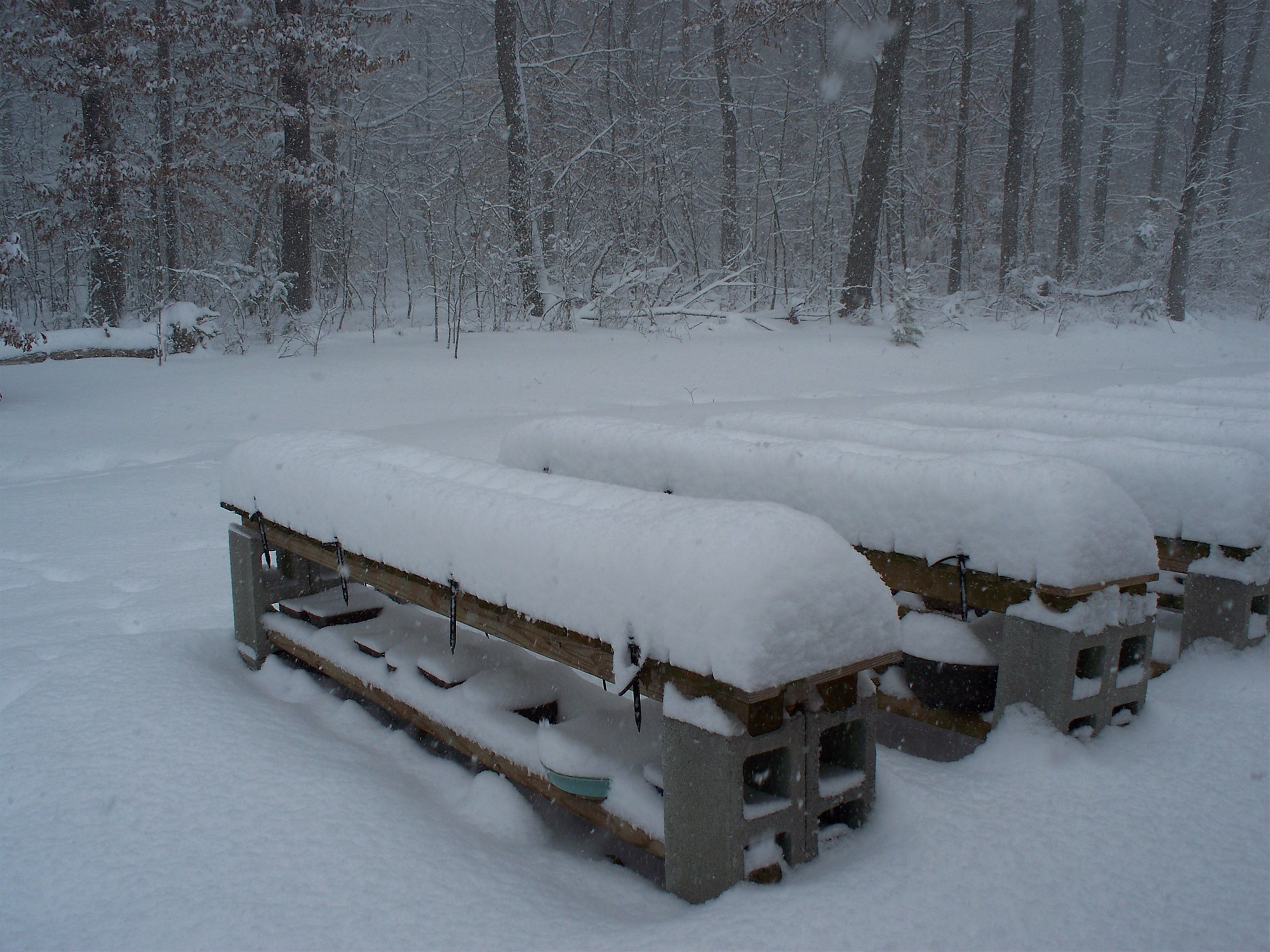
Header photo: my benches after a March snow, 2008.


Leave a Reply