 Skip to content

Ask a bonsai professional who they studied with and you’ll usually get a name, then a garden, then the name of that teacher’s teacher. To someone new to bonsai it can sound like pedigree for its own sake. It isn’t. It’s the most useful thing you can know about where someone’s methods came from.
Why lineage matters in bonsai
Bonsai technique is learned with your hands, at a bench, over years. Books help, and so do videos, but the timing of a cut, how hard to bend a branch before it cracks, and when a tree is strong enough to work are learned by watching someone do it and then doing it while they watch you.
In Japan that happens through apprenticeship: years at one garden, doing the work the garden needs, until the teacher’s way of seeing a tree becomes yours. Each garden develops habits of its own, so a student carries a particular set of methods forward, and passes them on in turn.
That’s what lineage records. When you know who someone studied with, you know a good deal about what they were taught, what they’ll prioritize, and why their trees look the way they do.
How to read the diagrams on this site
The pages under Lineage and Artists include diagrams that read top to bottom: an arrow runs from teacher to student. Many of the names are gardens rather than people. The -en at the end of Mansei-en or Daiju-en means garden, and in Japan the garden and the family that runs it often carry the line together across generations. Where a person or garden has its own page, the diagrams link to it, so you can follow a line from one page to the next.
My own line
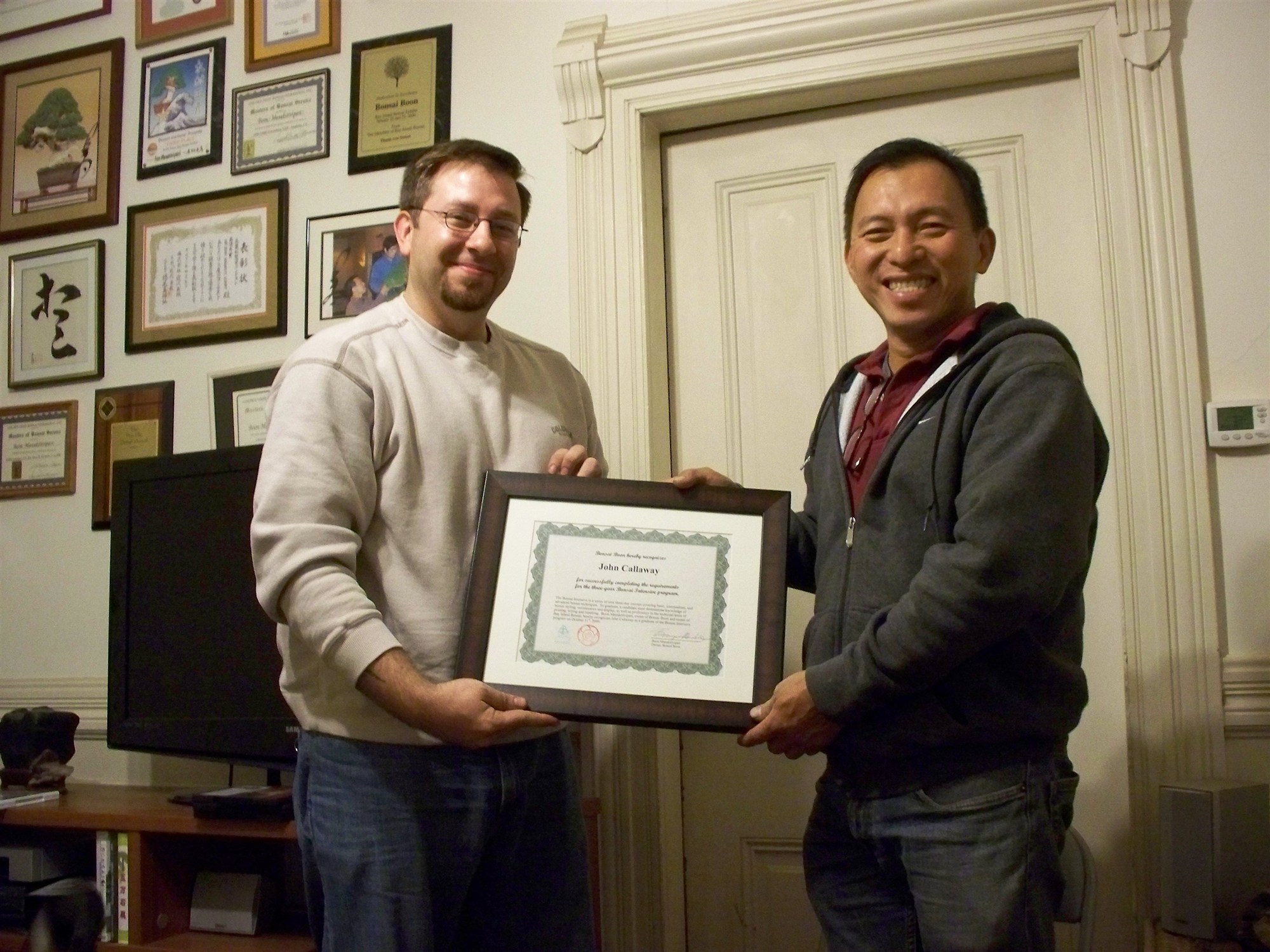
I studied with Boon Manakitivipart and graduated from his Bonsai Intensive in 2009, the twelfth person to do so. Boon apprenticed in Aichi, under Yasuo Mitsuya and then Kihachiro Kamiya. Kamiya had apprenticed at Daiju-en under Toshinori Suzuki, in a family garden known for its black pines. The Aichi-en page follows that line.
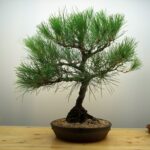
That’s a large part of why black pine is the center of my bonsai. The methods I learned from Boon came to him through gardens in Aichi with a long history of growing pines, and much of what I do at my own bench still follows them.
The same line runs through other people I’ve written about here. Akio Kondo, Kamiya’s first apprentice, is the Akio of Akio at Kirby’s, and he set the structure of the Kentucky Scots pine that I later refined.
Other lines on the site
The site covers other lineages too:
– Omiya. Mansei-en and the Kato family, including Saburo Kato, who did more than anyone to take bonsai abroad. Tōju-en, where Masaru Hamano trained, and through him Masahiko Kimura. – The United States. John Naka, who helped build American bonsai from the 1950s on.
More pages are coming, and each new one will link to at least one that’s already here, so the section grows into a connected map rather than a list.
What lineage doesn’t tell you
A famous teacher doesn’t make a good tree, and plenty of excellent growers learned from their club and their own mistakes. Lineage tells you where to look and what questions to ask. It doesn’t tell you what to think of the tree in front of you. Judge that on its own.
It also isn’t only for professionals. Most of us learn in a club, from members who’ve been at it longer. In my own club, the Greater Louisville Bonsai Society, several senior members now run small study groups, which is apprenticeship on a scale that fits around a day job.
Your own lineage starts with whoever first showed you how to wire a branch. Who was it for you? Tell me. I’d like to know.

Leave a Reply